You remember discussing a change. You cannot remember why you chose it, or which conversation settled the question. Reopening every chat and document takes you away from the work you meant to do.
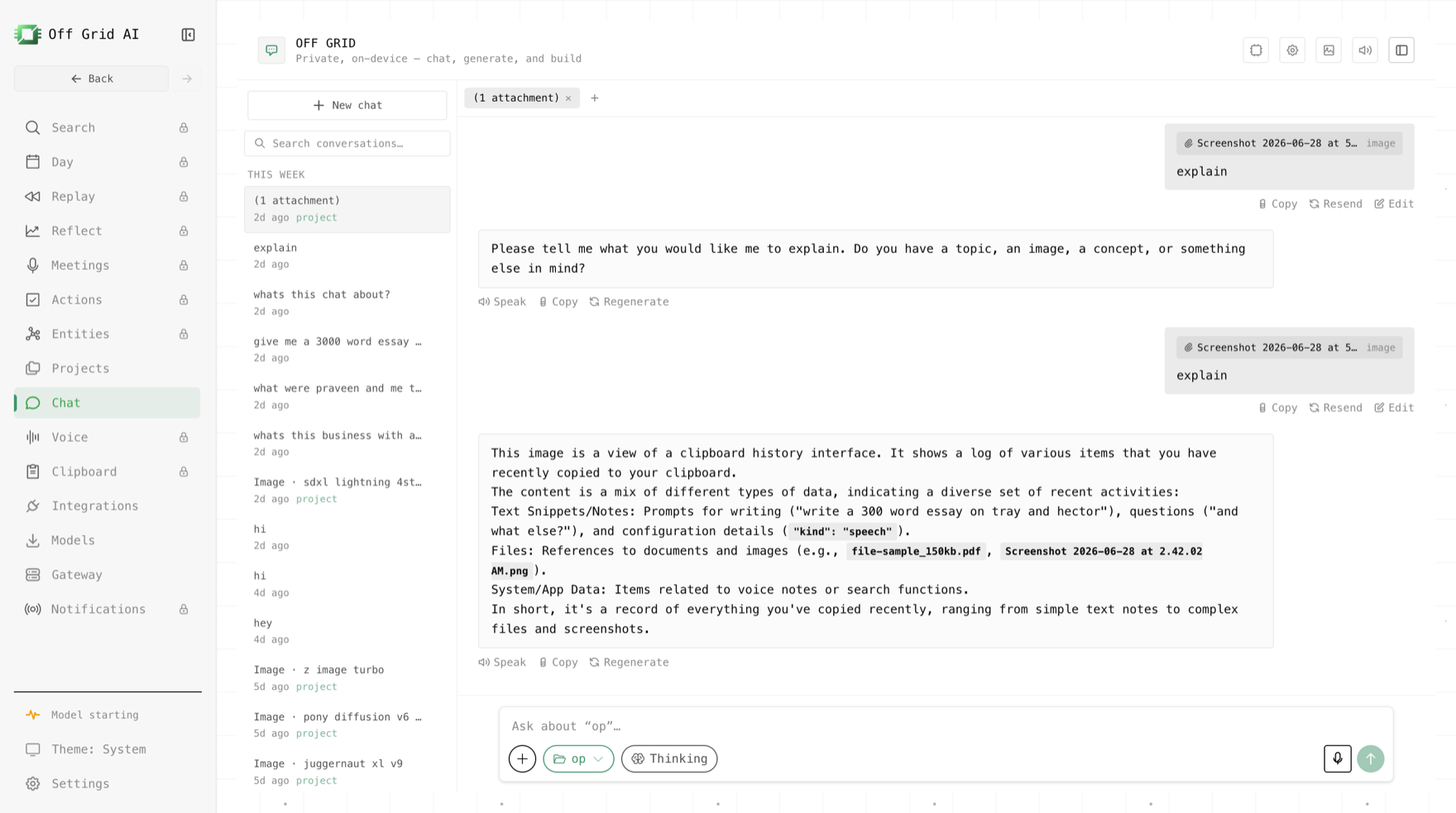
OGAD (Off Grid AI Desktop) Pro lets you ask questions about work captured on your Mac. Enable background capture, then use All memory in Chat to find relevant saved context and ask a local AI model to explain it. The answer can include sources you can open and check.
| Download OGAD for Mac | Beta 0.0.52-beta.103 |
What would you like to do with Off Grid AI?
Have a feature or use case you would like us to support? Tell us what you want to do and which device you use.
Write to support@offgridmobileai.co, join our Slack community, or talk to us on Reddit.
Recover the reason behind a decision
A useful question names the subject and the detail you need. Instead of asking for a summary of everything, try:
Search my captured work for the Atlas launch discussion. What reason did we give for moving the review date? Cite the saved sources. If the reason is missing, say so.
You can then ask a follow-up:
Which part was agreed, and which part was still a suggestion?
These are example questions to try with your own retained work. The model can only recover what was captured and indexed. A confident answer without supporting evidence is not a recovered fact.
The benefit starts before you ask. Once you enable capture, OGAD can build the local record while you work. You do not need to copy each useful passage into a separate AI conversation first.
Prepare the record once
This guide uses the Mac Pro workflow in the linked beta. Prepare a local text model that supports tool calls, the local capture-analysis models, and required local embedding downloads. Complete model downloads and Pro activation while connected.
In Settings > Setup & health > System permissions, review Screen Recording and Accessibility. Then open Replay or Capture settings and select Resume capture. Check the visible Capturing state.
Capture saves sampled screens and available text. It does not record every second, and it cannot recover work from before you enabled it. Screen capture also does not mean that your microphone is always recording. Meeting audio has a separate recording workflow.
Use local models for capture analysis and chat to keep this workflow on your Mac. Choosing a remote model sends the context needed for its answer to that model’s server. Pause capture whenever you do not want the current work added to the record.
Ask your first question
- Complete a short work session with capture enabled. Allow the saved observations to finish processing.
- Open Chat and start a new conversation with your local text model selected.
- Open the memory selector near the message box. Select All memory.
- Open the + composer menu and check that Tools is On. Memory search needs this setting.
- Ask about a specific subject from the captured session. Include a distinctive name or phrase and ask for sources.
- Check the memory-search result and open the source cards that support the answer.
The released memory-search implementation retrieves relevant retained records for the model. It does not put your whole work history into every answer. All memory makes that search available; the model still needs to use it successfully.
Check the answer before you act
Source cards show which retained material informed the reply. A saved screen can open in Replay. Other available sources can lead to their meeting or chat view. Compare the answer with the actual saved wording before you use it in a client reply or project decision.
You can ask the model to turn a checked answer into a draft:
Draft a short update explaining the agreed reason. Use only the facts supported above. Leave out assumptions.
Review the draft before sending it yourself. Finding a past commitment does not prove that the work was completed or that the decision still applies today.
For automatic task collection, use Actions > To do. That list can receive commitments extracted from captured communication. Chat helps you ask questions about retained context; it does not guarantee that its answer is a complete list of open tasks.
If the answer misses the detail
Use a narrower question with the person’s name and topic. Check that All memory is selected rather than No memory or a project, and that Tools is on. Look for evidence that memory search ran.
If there is still no match, search for the phrase in Search or inspect the saved session in Replay. Missing capture, processing gaps, and deleted records cannot be fixed by asking the model to guess.
Use a recovered decision in the next piece of work
Suppose the saved sources show that you moved a review because two required mockups were missing. Open the source card and verify that this was the agreed reason, not one possibility raised during the discussion. Then ask for a draft update based only on that checked fact.
A useful draft should say what changed and what is still unresolved. If the saved discussion does not give a replacement date, the update should leave that date open. The purpose of recall is to preserve the actual decision, not to produce a more complete story than the record supports.
Before sharing the update, check whether newer work changed the decision again. Search for the same project name and the later conversation if needed. A correctly recovered past decision can still be out of date today.
You can use the same pattern for another question: why a requirement was removed, which option a client preferred or what you agreed to check next. Name the subject, retrieve the retained evidence, inspect the source and only then turn it into new work. The background record saves you from copying every useful moment in advance; the source check keeps the answer tied to what was actually retained.
Try OGAD on your Mac with one work session you choose to capture. Ask why you made one decision, open its source, and continue your work with the reason in front of you.