Before sending a deliverable, you need to know whether it answers the brief. OGAD (Off Grid AI Desktop) can help compare the draft with the client’s requirements and turn possible gaps into a review checklist. Use a local model to keep the documents on your computer while you work. You still decide whether each requirement has been met.
| Download OGAD | Desktop releases |
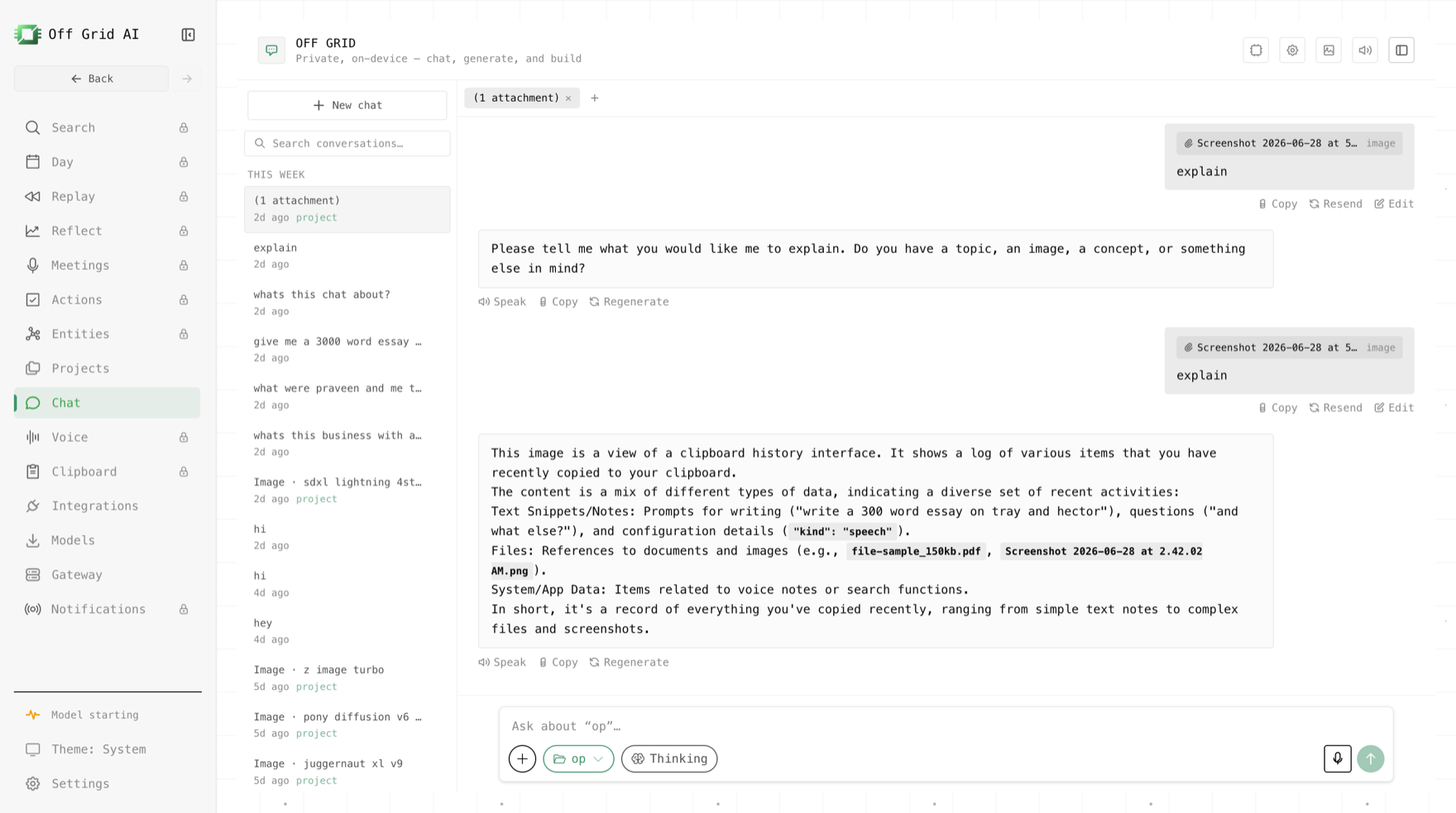
What would you like to do with Off Grid AI?
Have a feature or use case you would like us to support? Tell us what you want to do and which device you use.
Write to support@offgridmobileai.co, join our Slack community, or talk to us on Reddit.
Make the review concrete
“Does this look good?” is a difficult question to verify. “Does the draft explain the three onboarding steps in the approved brief?” gives you a claim you can check.
Suppose you are delivering a website copy draft. The brief requests a short explanation of the service, three customer examples, and a clear next action. The draft contains the service description and an invitation to book a call, but only two examples. A useful AI-assisted review should identify that specific gap and show where it looked.
This workflow produces a requirements table and a revision list. It does not provide automatic client acceptance or a quality certificate.
Choose the authoritative brief
Find the version that the client has approved. If later emails changed the scope, create a short checked change note and include it as a separate source. Label it clearly with its date and status.
Avoid importing several versions with similar filenames and expecting the model to infer which one is current. Name the sources, for example, Approved-brief-v3.txt, Approved-changes-September.txt, and Draft-for-review-v2.docx.
Keep “nice to have” suggestions separate from contractual requirements. An old brainstorm is not a reliable checklist for final delivery.
Prepare the local workspace
Install OGAD, download a local text model that fits your computer, and complete the first document import while connected. Projects and document chat are core features. This review does not require a recording or background activity capture.
Use readable PDF, DOCX, TXT, or Markdown sources. The desktop extractor extracts document text. Layout, animation, interactive behavior, and visual quality need separate inspection in the actual deliverable.
- Choose a local model under Models > Text.
- Create a project through Projects > New project.
- Open Knowledge & settings > Knowledge base > Add files and import the approved brief, change note, and draft.
- Wait for indexing and check that the relevant files are enabled for retrieval.
- Turn off Include captured memory, if available, for this document-only review and save.
- Start Chats > New chat inside the project.
Convert the brief into a checked checklist
Ask for requirements before asking the model to judge the draft:
Extract the explicit requirements from the approved brief and approved change note. Make one row per requirement. Include the source filename, a short supporting passage, and whether it is mandatory, optional, or unclear. Do not add general best practices as requirements.
Check that list yourself. A requirement such as “three customer examples” should remain a countable item. “Friendly tone” needs a review criterion, but the model should not pretend it is as objective as a missing page.
Assign simple labels such as R1, R2, and R3 to your reviewed list. These labels make later edits easier to discuss without repeating long passages.
Compare one requirement at a time
Use a focused request:
Compare draft v2 with requirements R1–R5 below. For each, provide draft evidence, status, and the smallest useful revision. Use these statuses: supported, partly supported, not found in reviewed text, or needs human judgment. Do not treat “not found” as proof that the entire file lacks the item.
Paste the reviewed requirements. Check each cited passage in the draft. Where the model says “supported,” ask whether the evidence actually satisfies the requested outcome or merely mentions the same topic.
| Requirement | Useful review question |
|---|---|
| Three customer examples | Are there three distinct examples, rather than three mentions? |
| Clear next action | Can the reader tell what to do and where to do it? |
| Explain implementation | Are the steps usable, rather than just named? |
| Approved terminology | Does the draft use the client’s exact terms consistently? |
| Stated length limit | Does a word count in your editor confirm it? |
Use external checks for objective properties such as word counts, links, and file formats. The model’s estimate is not the final test.
Separate missing content from quality concerns
A missing example requires a different action from a weak example. Ask the model to make that distinction:
Split the revision list into missing required content, unclear required content, and optional improvements. Keep each suggestion linked to a requirement or label it optional.
This keeps the review from expanding the scope every time the model produces another idea. You can finish a deliverable without accepting every suggestion for improvement.
For the website copy example, the missing third customer example is required. Rewriting every heading may be optional unless the brief specifies a heading style.
Turn the findings into a manageable revision pass
Choose the changes you agree with. Ask for a revised passage, rather than an uncontrolled rewrite of the complete document:
Rewrite only the implementation paragraph to address R4. Use the facts already present in the draft. Leave an explicit placeholder for information that is missing. Do not change the commercial terms or add new claims.
Paste the revision back into your document tool, then check the changed section against the brief again. Keep the final wording under your control.
If the requirement depends on design or software behavior, test the real output. A text review cannot establish that a page works on mobile or that a form submits successfully.
Avoid false confidence on long files
Project chat retrieves relevant excerpts within a context limit. It may not inspect every paragraph in a long draft. Review the requirements in small groups and use the document outline to track coverage.
If a section repeatedly fails to appear, import a checked text extract or paste that section directly into the conversation. Record what you reviewed, especially for appendices and attachments.
Send a clearer delivery note
When the checklist is complete, use your checked findings to write the delivery note. State what is included, which revision it is, and any open point that needs client input. Do not write “all requirements verified” unless your own review supports that claim.
Download OGAD and compare one draft with three explicit requirements. A small, source-backed check is an easy first step toward a more reliable delivery review.