
The first AI answer is not always the one you want to use. You may like its facts but want a clearer explanation, a stronger opening, or a different order.
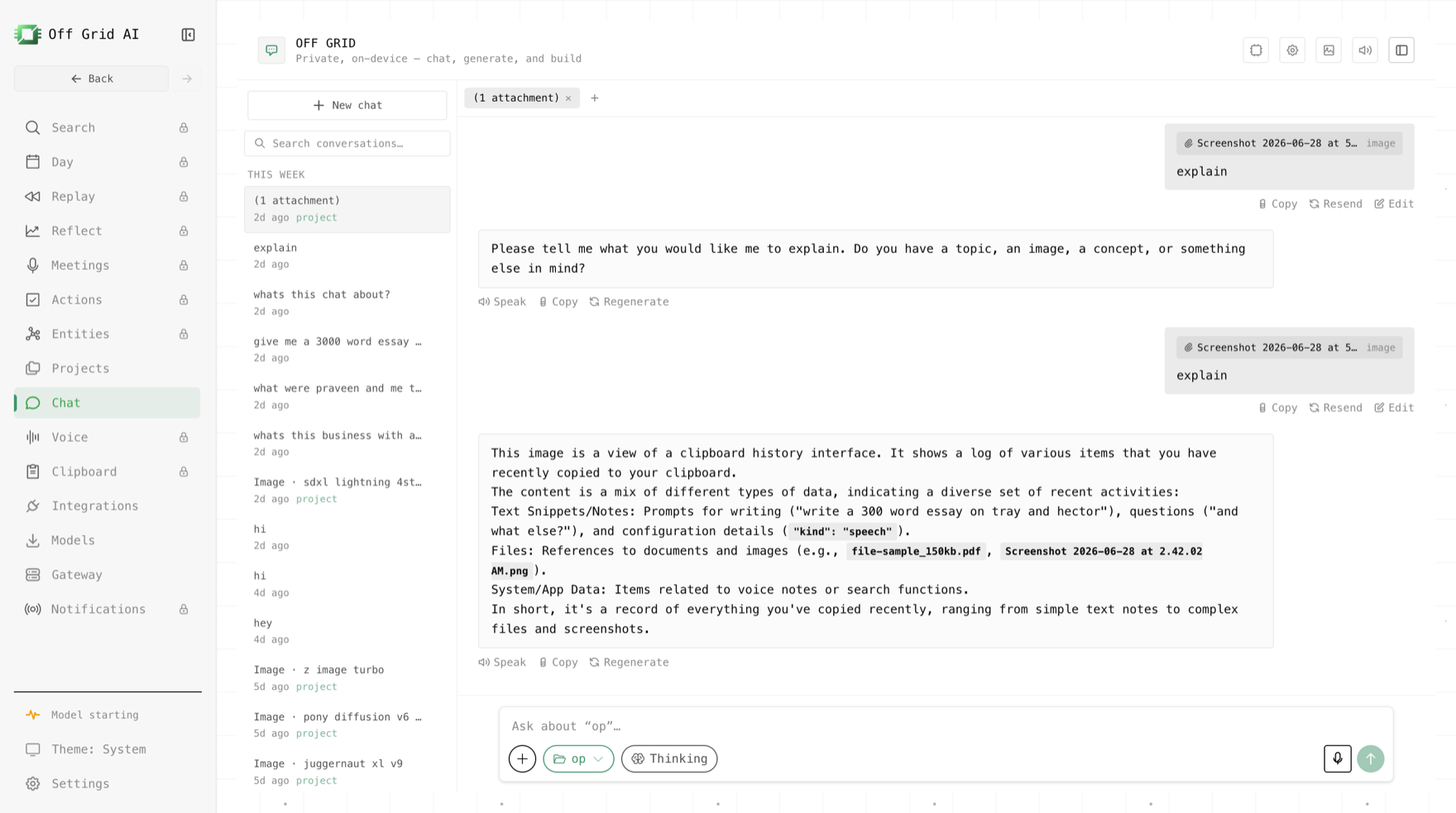
OGAD (Off Grid AI Desktop) lets you regenerate a text answer and move between its alternative versions. With a downloaded local model selected, you can compare those answers on your Mac or Windows computer without sending the prompt to a cloud model.
What would you like to do with Off Grid AI?
Have a feature or use case you would like us to support? Tell us what you want to do and which device you use.
Write to support@offgridmobileai.co, join our Slack community, or talk to us on Reddit.
What is worth comparing?
Use this when your prompt is already clear and you want another attempt at the same task. A useful first example is a short explanation for a reader who is new to your subject:
Explain the difference between a file backup and file sync to a beginner. Use one everyday example, then three short points. Keep the answer under 180 words.
Read the first answer before generating another. Does it explain that a synced deletion can reach another device? Is the example easy to understand? Does the wording fit the person who will read it?
These questions give you a reason to choose a version. More versions alone do not produce a better result.
Generate another version without retyping the question
You need OGAD and a downloaded text model that runs on your computer. This is a core desktop chat workflow in OGAD 0.0.51. Initial app and model downloads need internet access; generating with the local model can then work offline.
- Open a chat and select your local text model.
- Send a short, specific prompt and let the answer finish.
- Open the answer’s actions and select Regenerate.
- When the new answer finishes, use the answer’s left and right variant controls to move between versions.
- Copy the version you want to keep in your document.
Start with the latest answer in the conversation. Regenerating an earlier answer replaces the conversation after the user message that produced it. Save any later material you still need before doing that.
The controls let you read alternatives in the same place. They do not score the answers or decide which one is correct.
Choose for the job, not for the longest answer
For an explanation, look for a clear distinction and a useful example. For a draft, look for a strong opening and a logical order. For instructions, check that the steps can be followed in the order given.
| Your task | What to check in each version |
|---|---|
| Explain a technical idea | Correct terms, a useful example, no missing condition |
| Write an announcement | Clear main point, specific next action, suitable tone |
| Create a checklist | Steps you can act on, no repeated items |
| Summarize supplied notes | Facts kept intact, no invented decisions |
Check facts against your source even when a new version sounds more confident. Regeneration produces another model answer; it is not independent fact checking.
If every version misses the same point, change the prompt. Tell the model what is missing, who the reader is, and what form you need. A more precise request usually gives you a better basis for comparison than repeatedly asking an unclear question.
Why might two versions look similar?
A focused prompt and conservative model settings can produce similar answers. That can be useful for instructions where consistency matters. It does not mean the button failed.
For a fair first comparison, keep the same model, prompt, and settings. Changing several things at once makes it harder to tell what helped. If you later change a writing setting, record the old value so you can return to it.
The local model still needs enough memory and time to generate each version. Wait for the current reply to finish before you regenerate it.
Try OGAD with one explanation you need to write today. Generate a second version, compare both against your reader’s needs, and keep the clearer one.