On this page
A Teams handover includes owners, dates, and several open questions. A local transcript gives you a place to check those details after the call. OGAD (Off Grid AI Desktop) Pro can record the call on your Windows computer and create a transcript and summary afterward. With local speech and text models selected, the note-making step does not upload the recording to another AI service.
| Get OGAD for Windows | Desktop releases |
What would you like to do with Off Grid AI?
Have a feature or use case you would like us to support? Tell us what you want to do and which device you use.
Write to support@offgridmobileai.co, join our Slack community, or talk to us on Reddit.
Prepare the Windows beta first
Use the x64 Windows installer from beta 114, with Pro active. Prepare downloaded local models for any AI processing used below. Initial downloads and licence setup can need internet.
For screen-based history, review Settings > Setup & health, allow the requested system access, then explicitly choose Resume capture in Replay or Settings > Capture. Check the visible Capturing state. Use Pause capture when you do not want new screen history retained. Imported calendar records, manually entered tasks, and notification controls are separate choices.
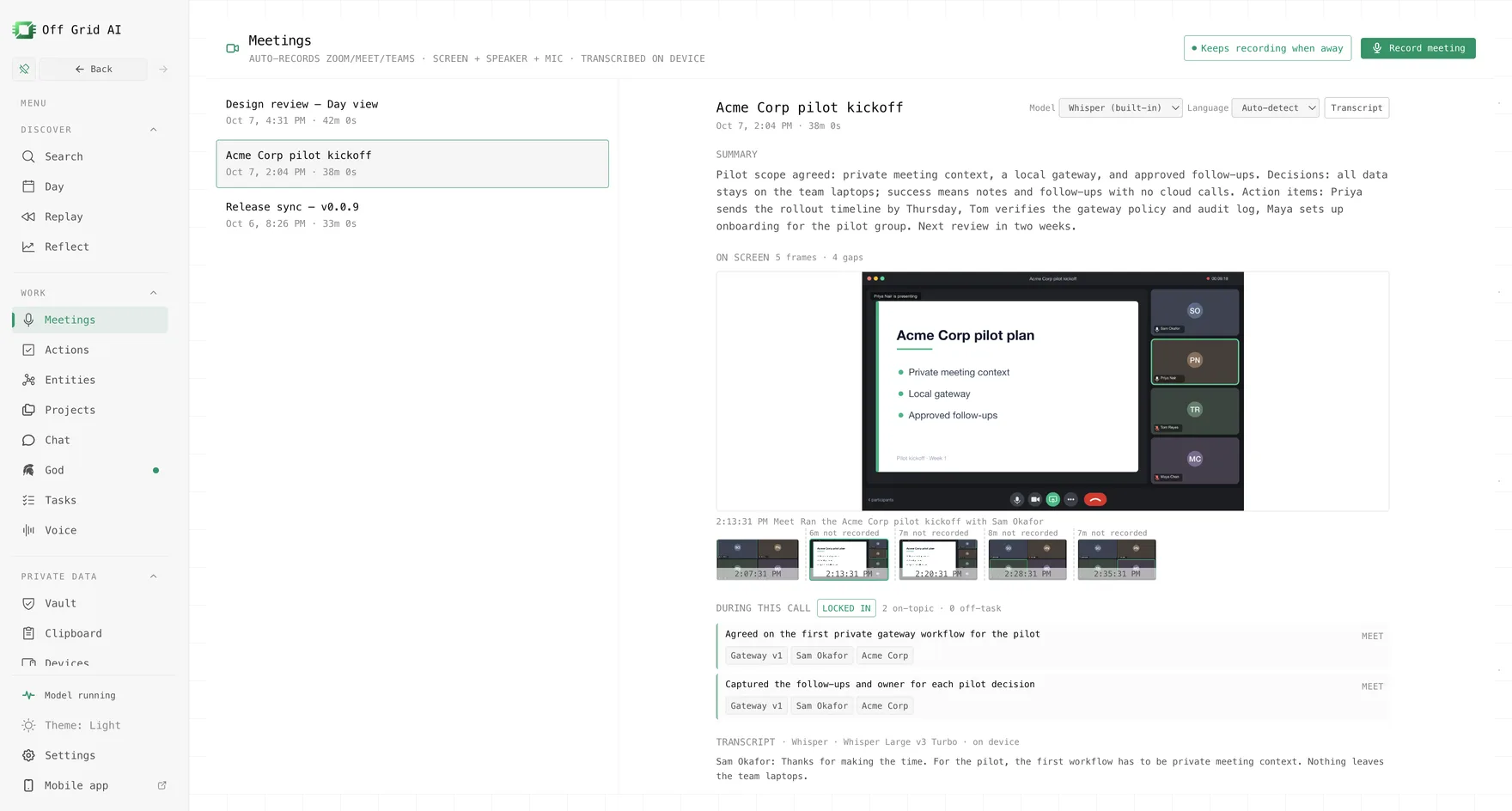
The useful result is a meeting record you can review: what was discussed, the decisions that appear in the transcript, and possible next steps. The summary is a draft to check, not a guarantee that every part of the call was captured.
What happens automatically?
With Pro active and OGAD running, granting the recording permissions enables automatic meeting capture. There is no separate automatic-recording switch in this version. A detected supported call starts recording; after you stop and save it, OGAD creates the transcript and summary. Confirm the visible recording indicator each time rather than assuming a call was detected.
Teams calls can appear in an app or a browser. Check the visible recording state for the call you are using; a Teams window being open does not by itself establish that usable audio is being captured.
Recording has a visible indicator and Stop control. This workflow can capture meeting screen content as well as speaker audio and your microphone. Make sure the people in the call agree to the recording before you begin.
What do you need first?
Prepare Pro and the local models. Select a local model in Models > Transcription and a local text model in Models > Text. Allow microphone access in Windows. The recorder captures system audio and the microphone through separate paths, so check both sides in a short call.
Zoom or Teams still uses its normal network connection for the meeting. Local notes refer to OGAD’s transcription and summary stage, not the call service’s traffic.
Getting started with a short call
- Review the beta setup and allow the system access requested for this workflow.
- Leave OGAD running and join a short Teams call. Keep the live call window visible. A recognized meeting window triggers recording; the Teams app being open by itself does not. Use an agreed sample with one owner, one date, and one unresolved question.
- Open Meetings in OGAD. Check the recording indicator; if recording has not started, use Record meeting.
- Say a short sentence and have another participant say a different one. This helps you check both audio sides later.
- Select Stop in OGAD when the sample is complete.
- Wait for processing, then open the saved meeting’s Summary and Transcript.
The expected result is saved meeting media, recognized text, and a generated recap when the models complete successfully. Replay the sample and check that both voices reached the transcript before using the setup for an important call.
What should you check before using the notes?
Check names, amounts, decisions, and assigned work against the transcript and recording. A model can turn a suggestion into a decision or attach an action to the wrong person.
The recorder can distinguish your microphone track from the other side of the call. Do not assume it reliably identifies each remote participant by name. Several people speaking through the call audio may share the same broad speaker label.
For a long meeting, review later sections of the transcript too. The automatic summary uses a limited amount of transcript text, so it can miss material near the end. Use the full transcript and recording when a complete record matters.
What if part of the meeting is missing?
| Symptom | Check | Action |
|---|---|---|
| Only your voice appears | System/screen-audio capture | Recheck recording permissions and a short two-sided sample. |
| No transcript appears | Local speech model and processing status | Select a ready local model and use Retry transcription when offered. |
| Recognition is poor | Recording quality and speech model | Review the audio and compare another downloaded model. |
| A recap is incomplete | Transcript coverage and summary scope | Check the full transcript, especially later discussion. |
Use Stop deliberately when finished. In beta 114, a detection-started recording can stop after the call is no longer confirmed: the default policy waits five minutes, warns for 20 seconds, then stops. A manually started recording follows the separate away-stop setting. There is also a four-hour cap. Do not use call exit as an exact stop timer.
Can you keep a copy of the transcript?
The saved meeting provides a Transcript export control. Check the text before sharing it. Exported files and copies you send elsewhere have their own storage and privacy behavior.
Download OGAD, prepare Pro and the local models, then check a short Microsoft Teams recording from start to saved notes before your next full meeting.
This guide covers OGAD beta 0.0.55-beta.114. The release and build record identify the desktop version and its included Pro code. Setup details follow that code; they are not a device test.