You may have done strong work and still have a promotion case that does not show it clearly. OGAD (Off Grid AI Desktop) can help compare your draft with the role criteria and identify claims that need better evidence. Use a local model to review the material on your computer without uploading internal feedback or work notes to a cloud AI service.
| Download OGAD | Desktop releases |
What would you like to do with Off Grid AI?
Want help with this workflow, or a feature you would like us to add? Email support@offgridmobileai.co with your devices and the task you want to improve.
Look for the gap between a claim and its support
A promotion case is easier to assess when each important claim points to a concrete example. “I have taken on more responsibility” is a starting point. A dated account of a decision you owned, the work it affected, and the result gives the reviewer something to evaluate.
Suppose your draft says you now operate independently, but the examples describe only tasks you completed. The missing evidence may concern how you chose priorities, handled uncertainty, or decided when to ask for help. The model can help expose that mismatch without inventing an example.
The output should be an evidence checklist and questions for your manager. It cannot determine whether you deserve a promotion or predict the decision.
Use the actual criteria
Find the current role expectations or promotion guidance that applies to you. If there is no written framework, ask your manager what the review will consider and record the answer accurately.
Do not substitute a generic internet description for your organisation’s criteria. “Leadership” can mean different things at different levels. A criterion about influencing a project is not necessarily a requirement to manage staff.
Prepare a small source pack:
| Source | Purpose |
|---|---|
| Current criteria | Establish what the case must address |
| Promotion draft | Show the claims you are making |
| Project notes | Support actions and decisions |
| Feedback you can use | Add another person’s documented view |
| Verified results | Support outcomes without estimates |
Check what feedback you are permitted to include. Keep unrelated personal information out of the review.
Create a local evidence-review project
Install OGAD, download a local text model, and complete the first document import while connected. Projects and document chat are core features; this exercise does not require background recording.
- Choose your downloaded model under Models > Text.
- Open Projects > New project and name the review.
- In Knowledge & settings > Knowledge base, use Add files.
- Add readable PDF, DOCX, TXT, or Markdown sources and wait for indexing.
- If Include captured memory is available, disable it for this source-only exercise and save.
- Start Chats > New chat inside the project.
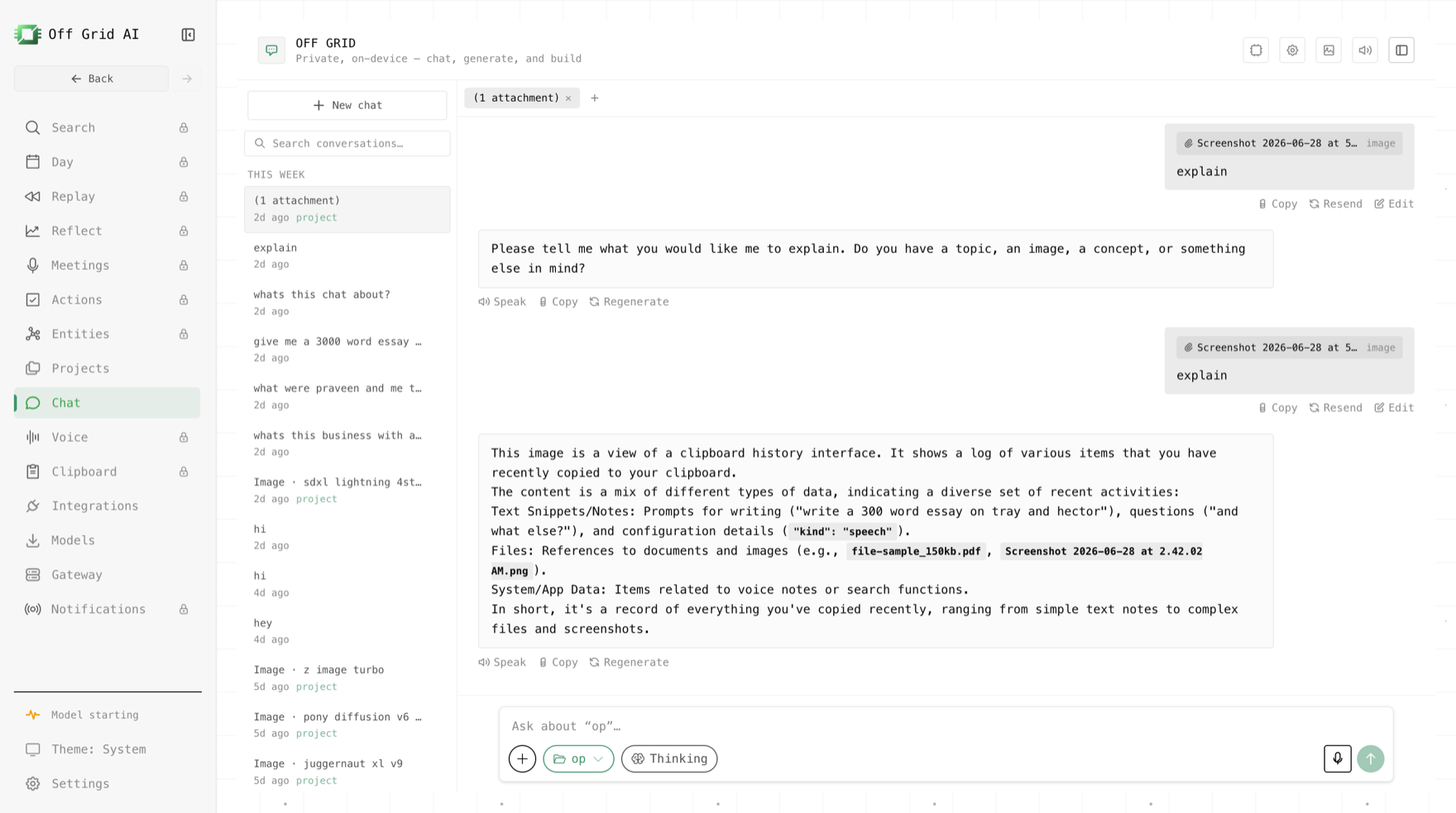
The Projects interface provides the file and instruction controls. Keep the selected model local and avoid external tools for the offline review.
Build a claim-to-evidence table
Ask for a first pass:
Compare my draft with the supplied promotion criteria. For each criterion, identify the claim I make, the supporting example, the source file, and what remains unproven. Distinguish missing evidence from unclear writing. Do not invent achievements, metrics, feedback, or additional criteria.
Check the table against the sources. If a model says evidence is absent, search the original notes before accepting that conclusion. Retrieval gives the model selected passages, not the complete archive in every response.
A useful status system is: supported by checked evidence, needs a clearer explanation, needs evidence, or not applicable pending confirmation. Avoid numerical scores that imply a precision your organisation has not defined.
Separate four common gaps
| Gap | What to do next |
|---|---|
| A claim has no example | Find a real example or remove the claim |
| An example shows activity but no outcome | Explain the verified result or learning |
| A team result hides your role | State your contribution and others’ contributions |
| An example does not match the criterion | Use a better example or clarify the connection |
Suppose you cite a successful launch as proof of independent judgment. Ask what decision you personally made and what information you used. If you only executed someone else’s plan, that example may support reliable delivery rather than independent planning.
Changing the label can make the case more accurate. You do not need to inflate the story to preserve every original claim.
Ask questions that help you recover evidence
Use the model to prepare a short investigation list:
For these unresolved claims, suggest questions I can answer from my records or discuss with my manager. Do not supply the answers. Focus on dates, decisions, scope of responsibility, observable outcomes, and available feedback.
You might need to locate a project review, confirm who approved a decision, or check a result in a report. Record the source as you find it so the final case remains traceable.
If the evidence does not exist, do not replace it with a confident estimate. You can state a narrower supported claim or discuss what evidence to collect during the next review period.
Rewrite only after checking the substance
Paste the reviewed facts and ask:
Rewrite this paragraph so the criterion, my action, and the supported result are clear. Keep the scope of my contribution accurate. Do not add an adjective that changes the claim, such as “company-wide” or “solely responsible,” unless my notes support it.
Read the revision next to the original. A more forceful sentence can become less accurate. Preserve team credit and uncertainty about outcomes where relevant.
Keep the final case concise enough for the reviewer to follow. Link or reference supporting material rather than filling the main narrative with every detail.
Prepare a useful manager conversation
Bring the criteria table and the few points you cannot resolve. Ask whether your chosen examples demonstrate the expected level and what evidence would make the case clearer.
This conversation can reveal a mismatch in expectations before submission. The model’s review is preparation for that discussion, not an alternative decision-maker.
Update your working notes after the conversation. Separate confirmed guidance from your own interpretation so future revisions do not treat a suggestion as a formal rule.
Finish with a factual check
Verify dates, figures, job titles, and attributed feedback. Remove confidential project details that the intended reviewers should not receive. Check the final exported document for working comments and unsupported claims.
Download OGAD and review one criterion against one example. A clear gap you can resolve is more useful than a polished paragraph that leaves the same question unanswered.