You do not need every available model to build a useful offline AI setup. OGAD (Off Grid AI Desktop) and OGAM (Off Grid AI Mobile) let you choose models for the tasks you need. Start with a short task list, check the displayed downloads, and leave room for your files and results. This gives limited storage a clear purpose instead of filling it with models you may never use.
| Download OGAD | Desktop releases |
What would you like to do with Off Grid AI?
Want help with this workflow, or a feature you would like us to add? Email support@offgridmobileai.co with your devices and the task you want to improve.
Choose the first result before the first download
Write down one or two tasks you want to complete without internet. For example, you may want to dictate short notes and ask questions about a small set of documents.
Those tasks need different components. Speech input needs a transcription model. Chat and document answers need a text model. Document search may also need its local indexing resources. Image generation has its own model files.
Do not assume that downloading one large text model prepares every modality. Likewise, do not download image or voice-output models if your first task does not use them.
Make a simple download plan
Use a table before you start:
| Task | Required component | Keep for the first setup? |
|---|---|---|
| Text drafting | Local text model | Yes, if this is a core task |
| Speech-to-text | Local transcription model | Only if you will dictate or transcribe |
| Document questions | Text model and local search setup | Yes, if you will use documents |
| Image generation | Compatible image-model package | Only if needed now |
| Spoken replies | Compatible local speech-output resources | Optional for a text-first setup |
Check the actual app catalog for the current download details. Some model packages include several supporting files. The headline model name alone does not tell you the complete installed size.
The goal is a working minimum, not the smallest possible file at any cost.
Distinguish storage from working memory
Download size tells you how much data must be stored. RAM is the working memory needed while the model and task run. A file that fits on disk may still be too demanding for the device’s available memory.
Keep these as separate checks:
- Does the model package fit in free storage?
- Can the device load it with enough memory for the task?
- Is there space for the source files and output?
- Can you complete the task while the other apps you need are open?
Do not choose a larger model simply because there is enough disk space. Test a suitable smaller option first.
Start with one model per required task
For a phone dictation setup, the catalog’s multilingual Base speech model is approximately 142 MB, while Small is approximately 466 MB. Those are examples of download sizes, not a promise of accuracy or total RAM use.
On desktop, the model files can differ from mobile files even when the short model name looks similar. Read the displayed size on the device where you will use it. Do not copy a mobile size table into a desktop storage budget.
Choose one local text model that fits your hardware and intended language. Add alternatives only when you have a concrete reason to compare them.
Check the mobile setup information if you are preparing a phone. Use the desktop model catalog for the computer part.
Complete the setup while connected
Download the app and the selected models on a reliable connection. Wait for each required package to finish. A partly downloaded model does not become usable just because you have enough space for it.
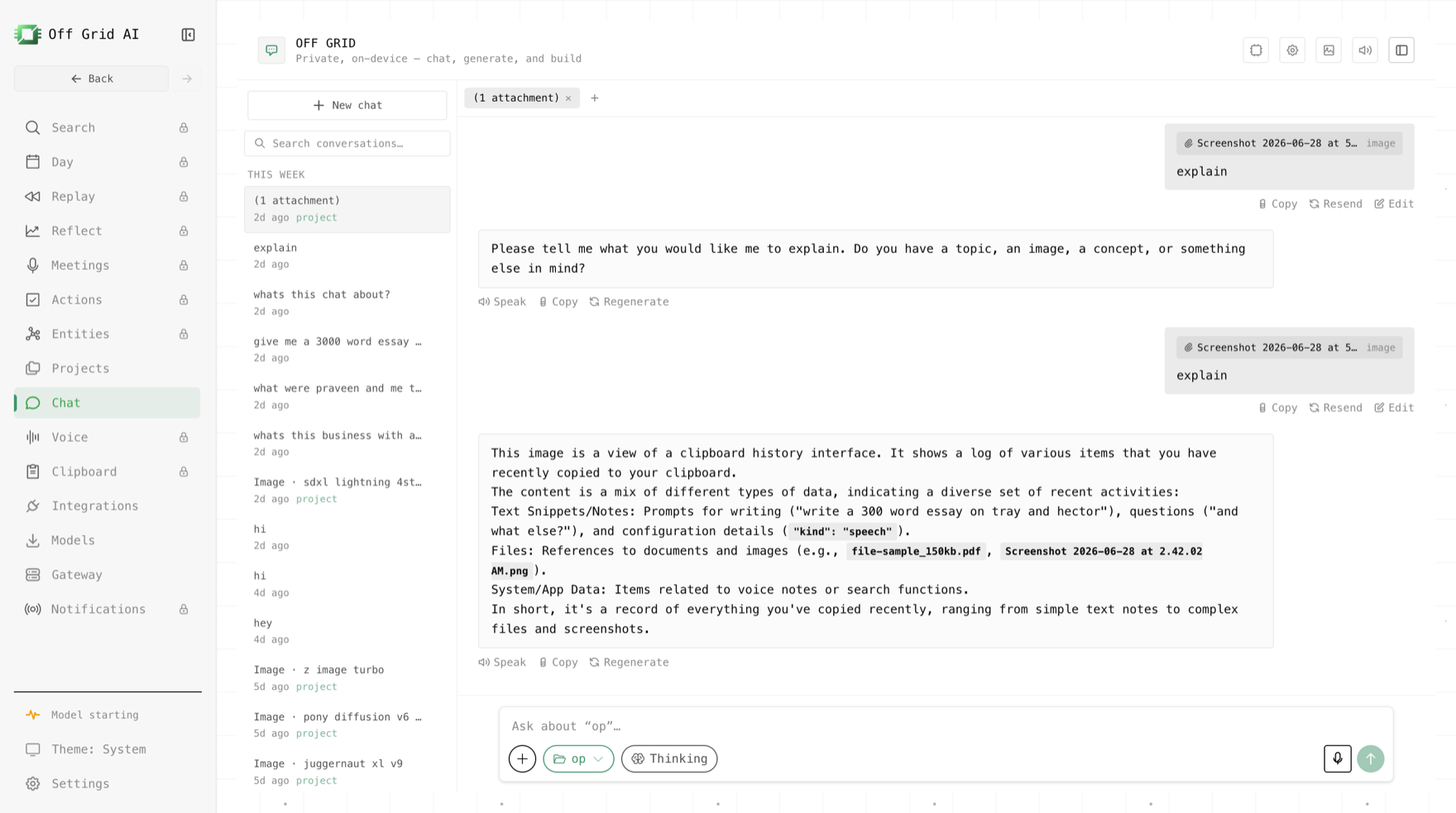
For OGAD document work, select a local text model, create a project, and add one readable source through Knowledge & settings > Knowledge base > Add files. Complete a successful import and question while connected so any required local search resources are ready.
The desktop project controls provide the file workflow. Keep the original document available locally as well as the indexed copy.
Budget for the files around the models
Models are only one part of an offline setup. You may also store documents, audio recordings, generated images, extracted text, and saved conversations.
Make a simple budget with these categories:
| Category | What to inspect |
|---|---|
| App and runtime | Installed application and required components |
| Models | Complete packages for selected tasks |
| Source material | Documents, audio, and other inputs |
| Working data | Indexes, extracted text, and app records |
| Results | Images, drafts, exports, and recordings you retain |
| Free space | Room for the device and future work |
Do not treat a sum of catalog downloads as the exact installed total. Check actual storage use in the operating system after setup.
Remove experiments deliberately
If you tried several models and only use one, review the unused downloads in the app’s model management controls. Confirm which model is active and what you still need before removing a download.
Do not delete folders at random or assume that removing a model also removes your chats and source files. Different data has different purposes.
Keep any model you need for an upcoming offline task until you have tested its replacement. A saved chat does not include a usable copy of the model required to continue it.
Test the complete setup without a connection
Turn off the relevant network connections and run your real task. Load the selected model, open the full local source, produce an output, and save the result.
For a phone, check both Wi-Fi and mobile data. For a computer, make sure the source is not a cloud placeholder. A test with a short pasted sentence does not prove that a cloud-hosted document will be available later.
If the task fails, identify the missing component before downloading more models. The problem may be an incomplete file, a remote model selection, or an unavailable local search resource.
Expand only when a task needs it
After the first setup works, add one capability at a time. Keep a note of why you added each model and whether you still use it.
A second text model may be useful for a specific language or task. A separate image package may be worth the storage if image generation is part of your regular work. The decision should follow a real need.
Download OGAD or get OGAM and prepare one complete offline workflow. Measure the storage after it works, then decide what deserves the remaining space.