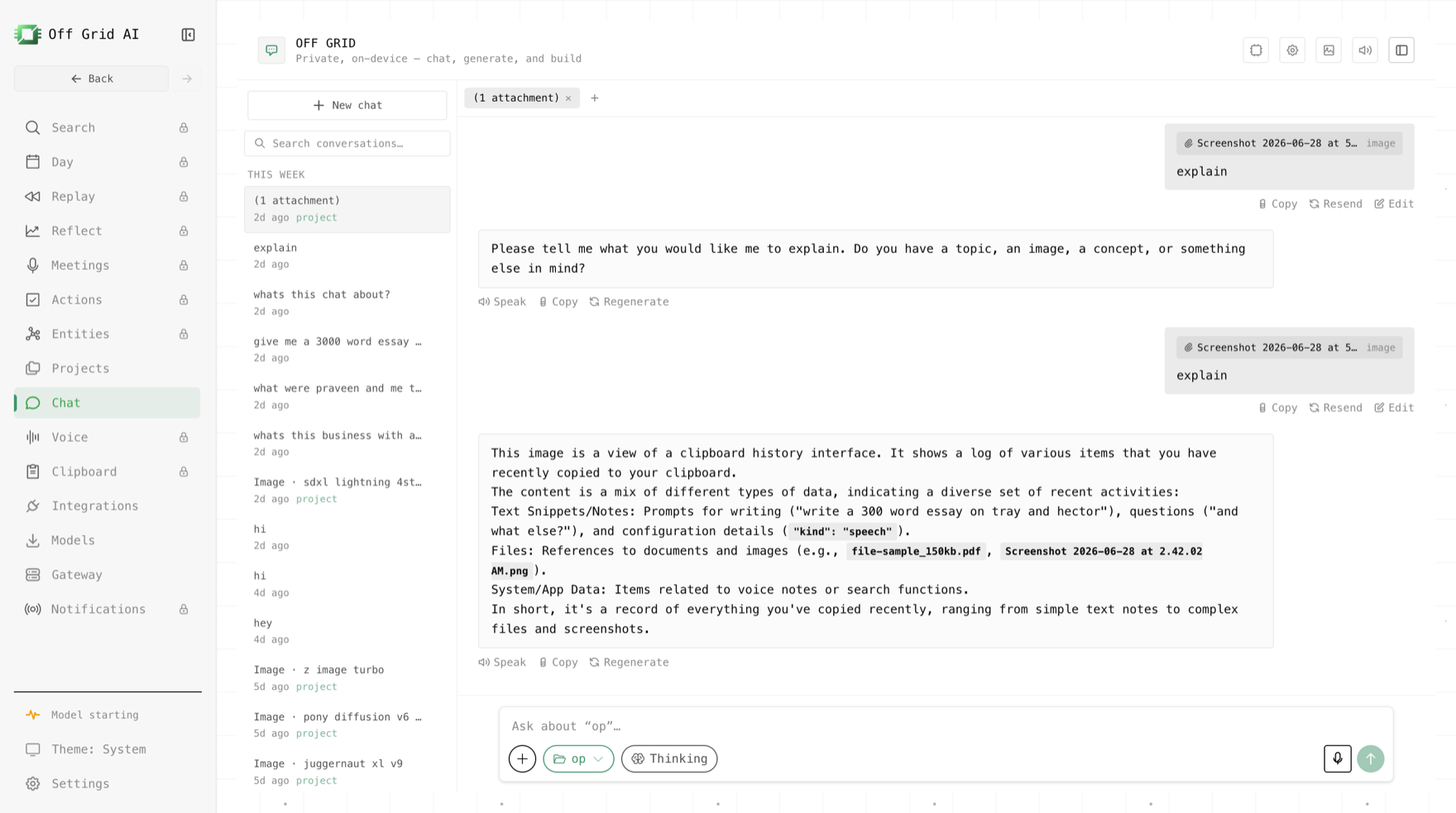
Copying a second item should not mean losing the first. OGAD (Off Grid AI Desktop) keeps a local clipboard history on Windows, so you can search earlier copied text and use it again. Once clipboard capture is active, supported new copies are added automatically while the app is running.
What would you like to do with Off Grid AI?
Have a feature or use case you would like us to support? Tell us what you want to do and which device you use.
Write to support@offgridmobileai.co, join our Slack community, or talk to us on Reddit.
This is useful when you collect links, move between documents, or replace a useful passage with a new copy by mistake. Clipboard is a Pro feature in the shipped Windows app. You do not need an AI model or a cloud clipboard account to use its local history.
Recover the copy you actually need
Open Clipboard in OGAD and search for a word from the item. Select the matching result to put it back on the system clipboard, then paste it into your destination. You can also open the quick clipboard with Ctrl+Shift+C and choose an earlier item there.
The history is useful only for content captured while the service was active. Installing the app today cannot reconstruct a copy that was overwritten last week before the app recorded it.
The released OGAD 0.0.51 Windows package includes this Clipboard workflow. Some screen hints may show the Mac shortcut symbol; on Windows, the global shortcut uses Control.
Turn a sequence of copies into reusable material
Suppose you are preparing a short reading list. You copy a page title, then its URL, then a useful quotation. With capture active, those supported copies can remain available as separate history items instead of only the last value surviving.
Search for part of the title or quotation when you are ready to assemble the list. Check the preview before pasting, especially if several items have similar wording.
You can add tags to useful items and search those tags later. A label such as “reading-list” is easier to recognize than the order in which you copied each item. This is a manual label you add, not a claim that AI automatically understands every clipboard item.
Decide what the history should retain
Open Clipboard → Settings and inspect Capture clipboard. Enable it when you want new copies saved; turn it off when you want capture paused. The release’s default setting is on, so check the control rather than assuming clipboard capture starts disabled.
You can also choose Keep history for and Maximum items. The retention choices include 7, 30, or 90 days, and Forever. The item cap still matters, so Forever is not a promise of unlimited storage.
Use Capture images if you want supported copied images included. They use more disk space than short text. Turn that option off when text-only history is enough for your work.
These settings are separate from screen-history capture. Pausing screen capture is not the same as pausing the clipboard service.
Getting started with a harmless copy
Test the flow with text that contains no secret. You should see it arrive without manually saving a clipboard entry.
- Open Clipboard → Settings and confirm the capture and retention choices.
- Copy “Reading list — first item” from a text editor.
- Copy a different line so the first is no longer the current system clipboard value.
- Open Clipboard and search for “Reading list”.
- Select the earlier result and paste it into a blank document.
For the quick route, focus the destination, press Ctrl+Shift+C, search, and select the result or press Enter. The popup attempts to paste into the previously focused app. If a shortcut conflict or destination restriction prevents that, use the main Clipboard screen to restore the item and paste manually.
Keep private copies out when you need to
A clipboard history can include sensitive material you copy. Review capture before handling passwords, API keys, or other private text. Turn Capture clipboard off when you do not want new items saved, and check other clipboard tools that may be running too.
The local history is separate from OGAD’s encrypted Vault. Do not treat an ordinary clipboard entry as a vault secret just because both features are in the same app.
If you enable device sync, review its copied-content sharing choices separately. Local clipboard history does not require you to share it with another device.
What if the item is missing?
Check whether capture was active at the time, whether the retention period or item cap removed the entry, and whether you have an active search or type filter. Clear the search to see the recent list.
If the entry exists but paste is wrong, inspect its preview and restore the intended item again. Focus changes can send a paste somewhere other than the field you expected, so check the destination before using the quick popup.
Use the item’s delete control for a copy you no longer want to retain, or Clear all for a broader history cleanup. Clearing the history is not a way to erase copies already pasted into documents or recorded by other apps.
Try the next two-copy task
Download OGAD for Windows, check the capture settings, and try the short two-line example. The next time a new copy replaces a useful one, you can search the history and bring the earlier text back.