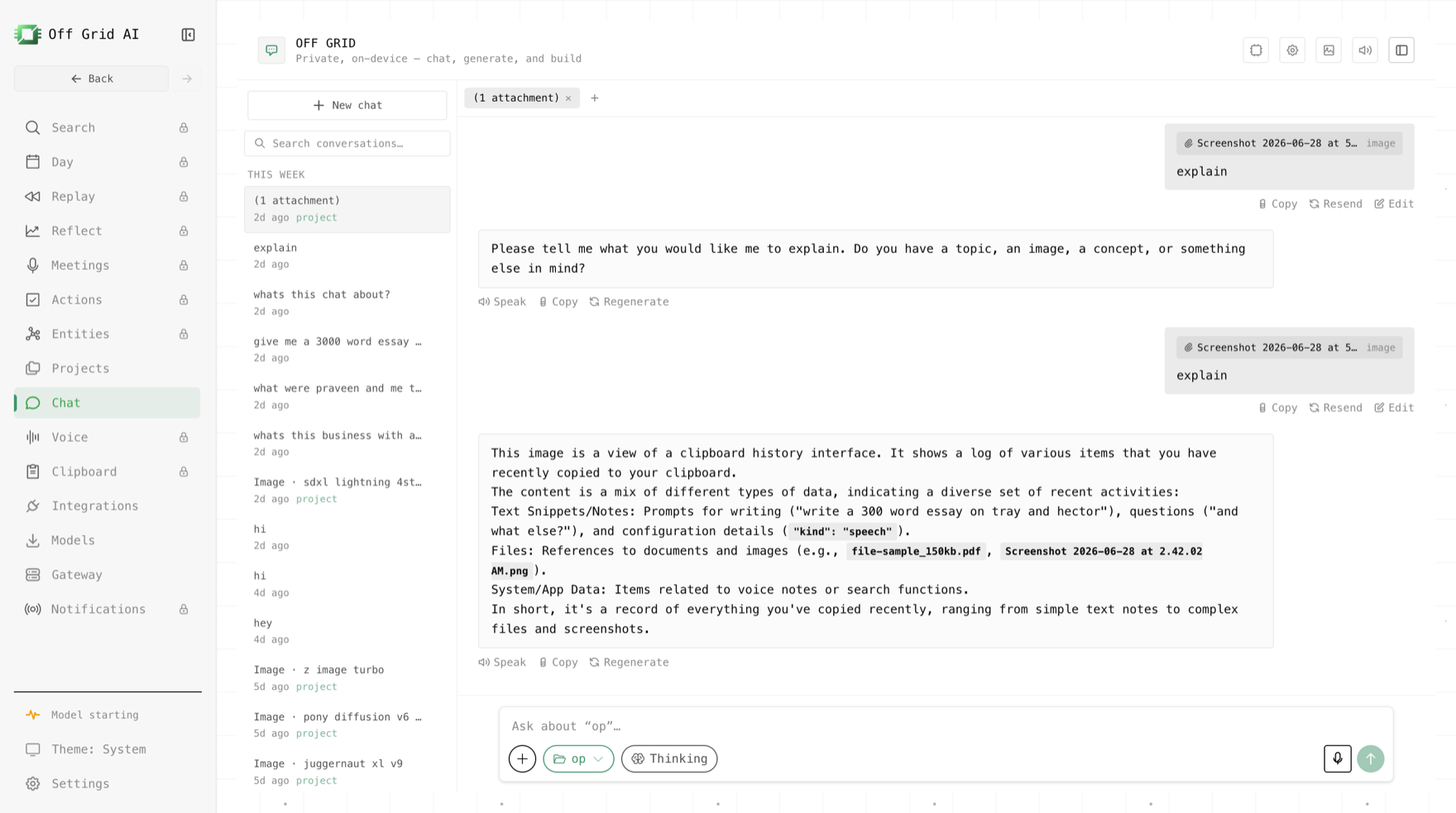
You remember reading the answer, but not which file contained it. OGAD (Off Grid AI Desktop) can search a project full of documents and use relevant passages to answer your question. The files and model can stay on your computer, so you can search without uploading the collection to a cloud AI service.
| Download OGAD for Mac or Windows | Desktop releases |
What would you like to do with Off Grid AI?
Have a feature or use case you would like us to support? Tell us what you want to do and which device you use.
Write to support@offgridmobileai.co, join our Slack community, or talk to us on Reddit.
Use it for a question such as, “Which notes mention the packaging change?” You can follow the source back to a file instead of opening every document in turn.
What do you need to search your documents?
Install OGAD, download a local text model that fits your computer, and collect a few readable files. Text PDFs, DOCX, TXT, and Markdown are useful starting formats. Projects and document search are free core features on supported Mac and Windows computers.
Complete the initial local search-model setup while connected. Scanned PDFs need a searchable text layer or a checked text version first. The document importer does not automatically read every picture inside a PDF.
How do you build the first searchable collection?
Create one project for a related set of files. Add them to its knowledge base and wait for indexing. Start a chat inside that project so your question uses the intended collection.
- Select a downloaded local model in Models > Text.
- Open Projects > New project, enter a name such as “Packaging research,” and press Enter.
- Open Knowledge & settings > Knowledge base > Add files.
- Select the related documents and wait for each to be indexed. Leave their retrieval switches enabled.
- Open Chats > New chat inside the project.
Give files useful names before importing, such as supplier-notes-2026-09.txt. The project retrieval format connects your question to indexed material; source filenames help you check the resulting answer.
How should you ask a cross-document question?
Name the topic and the detail you need. Ask for supporting files, and leave room for the answer to say that the sources are incomplete.
Which uploaded documents discuss changing the packaging material? For each relevant source you find, name the file, describe the proposed change, and quote a short supporting passage. Do not claim the list is complete if you cannot verify it.
The expected result is a useful set of leads with an explanation. Open each named document and check the passage. If two sources disagree, ask the model to show the difference without choosing a winner on its own.
For a follow-up, narrow the question:
Which source gives a reason for the change? Separate stated reasons from your interpretation.
Turn a search result into a decision you can explain
Imagine that your project contains a supplier note, a meeting summary, and a packaging test report. You want to know why the team considered changing materials. Do not begin by asking the model to recommend a purchase. First use it to locate the reasons recorded in those files.
Ask for a small table with these columns: source filename, reason stated, supporting passage, and unresolved question. Open each source and check that the reason belongs to that document. A supplier’s promise and your own test result are different kinds of evidence, even if both mention durability.
Then ask a narrower follow-up: “Which checked source discusses damage during shipping?” If no relevant passage appears, search the original files for the wording you expect. A missing result is a reason to investigate, not evidence that the topic was never discussed.
Keep your checked findings in a separate note. For example, “supplier note claims a thicker material; test report contains no shipping test.” That distinction gives you a next action: obtain the missing test evidence before deciding. OGAD helps you reach the source faster; you still decide what the source supports.
This method is also useful for finding a design rationale, a meeting decision, or the origin of a requirement. Start with where the information came from, then ask what it means for your present question.
Will it find every matching document?
Each answer uses a limited selection of passages. Semantic search can find related wording, but it can also miss an exact name, short phrase, or low-ranked passage. Treat the result as a way into the collection, not an exhaustive audit.
For a task where every occurrence matters, also use exact text search in the original files. Split a large question into dates, names, or subtopics and check them separately.
Keep unrelated research in other projects. Earlier chats in the same project can also affect context. If you use Pro, turn off Include captured memory in Knowledge & settings and select Save when you want the search limited to uploaded material and project discussion.
What if the answer uses the wrong source?
| Check | Action |
|---|---|
| The chat belongs to another project | Start from the correct project’s Chats section. |
| An old version is still enabled | Disable its retrieval switch and keep the current file enabled. |
| The filename is unclear | Use descriptive names and recheck the original source. |
| A file has no extractable text | Import a checked text version. |
| The question covers too much | Ask one narrower question and request its supporting passage. |
Disabling a file changes future retrieval. It does not remove a claim already written in the conversation. Start a fresh chat when old answers could confuse the next question.
Can you search while offline?
Yes, after the files are indexed and local model resources are available. Disconnect internet and ask a new question about the project. Keep the active text model local. External tools, remote models, and device sync have separate network behavior.
Get OGAD, add three related documents, and ask a question whose source you already know. Check the result before adding a larger collection.