
You have an interview recording in another language and need an English draft you can work with. OGAD (Off Grid AI Desktop) can help you transcribe the saved audio on your Mac, check the source text, and use a local text model to prepare the English version. Download both models first. The prepared workflow can run without uploading the interview to a cloud AI service.
| Download OGAD | Desktop releases |
What would you like to do with Off Grid AI?
Want help with this workflow, or a feature you would like us to add? Email support@offgridmobileai.co with your devices and the task you want to improve.
Keep transcription, translation, and drafting separate
These are three different tasks. Transcription converts speech into source-language text. Translation expresses that text in English. Drafting turns the checked material into the form you need, such as a research note or an article outline.
Suppose you interviewed a customer in Spanish about a delivery process. A transcription error in a date could survive into a fluent English paragraph. Separating the stages gives you a chance to catch it before it becomes part of the draft.
Keep the original recording. Work only with audio you are permitted to process, and follow the consent and handling arrangements for the interview.
What do you need on the Mac?
Use an Apple Silicon Mac with the desktop app, a downloaded multilingual local transcription model, and a local text model that handles the source language and English. The saved-file workflow uses core chat; it does not require the separate Pro meeting recorder.
Save the complete audio locally as a supported file such as MP3, WAV, M4A, AAC, OGG, Opus, FLAC, or AIFF. Check that it plays. A cloud-drive placeholder is not enough for offline use. If you recorded video, export its audio with a local tool first; video attachments use a different processing path.
Complete model downloads and test a short recording before disconnecting. Select local models for both stages. A remote transcription or text model changes where the material is processed.
Transcribe the source language first
- Open Models > Transcription, download a multilingual model, and select Use this model.
- Open its Settings and check Transcription > Current model.
- Under Spoken language, choose the interview language if available, or use Auto-detect with a multilingual model.
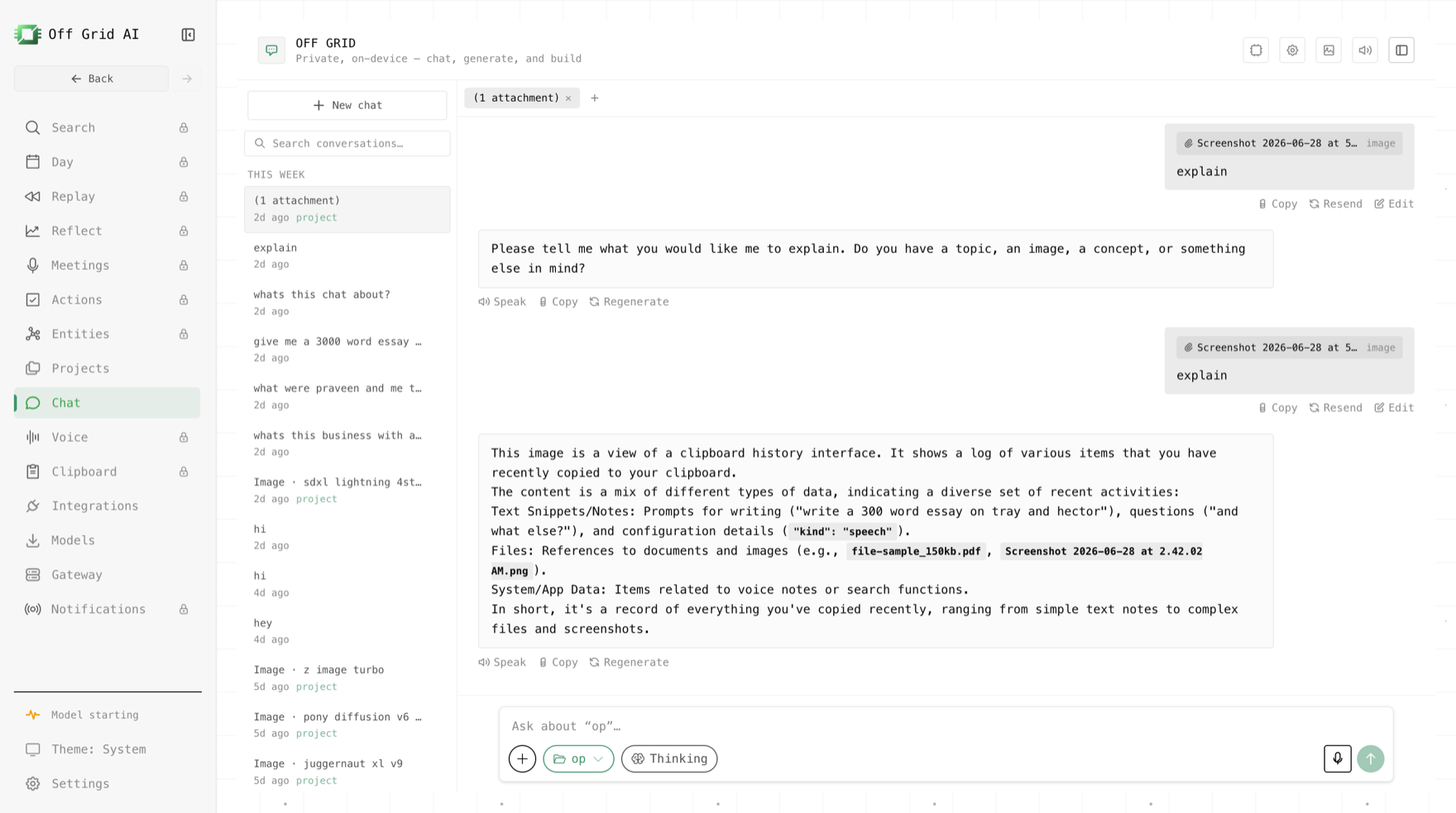
- Open Chat, select + > Attach files, and choose the saved audio.
- Wait for Processing… to finish, then click the attachment’s text preview.
An English-only model does not become multilingual when you change a setting. Choose a model appropriate for the recording. The local file-processing code routes saved audio to transcription before it becomes chat text.
The preview is a reading view. Copy the transcript into a local document to correct it.
Check the source transcript before translation
Listen to important passages while reading the text. Check names, dates, amounts, negative statements, and moments where speakers interrupt each other.
Do not assume the transcript has reliable speaker labels or timestamps. If you add labels manually, check them against the audio. Keep uncertainty visible with a note such as “word unclear” rather than guessing a name.
For a long interview, work in sections and check that the final answer is present. A long input can exceed the text model’s useful context. Number the sections so you can track coverage.
Remove the original pending audio attachment and attach your corrected TXT file when you are ready to use the checked transcript as the source for chat.
Create a close English version
Select your local text model and ask:
Translate this checked interview section into English. Preserve the speaker’s uncertainty, qualifications, and negative statements. Keep names, dates, and numbers unchanged unless I provide an approved equivalent. Mark phrases with uncertain meaning. Do not summarise or make the speaker sound more confident.
Review the translation next to the source-language transcript. If you cannot judge an important passage, use a fluent reviewer. The same model’s reassurance that its translation is correct is not independent verification.
A useful working table is:
| Source segment | English version | Review note |
|---|---|---|
| Checked passage | Close translation | Term or meaning to confirm |
| Checked passage | Close translation | Name or number checked |
| Unclear audio passage | Leave unresolved | Listen again or ask a reviewer |
Keep this working material separate from the final draft.
Turn checked material into the English draft
Only after reviewing the translation should you ask for a new format:
Prepare an English working draft from these reviewed interview notes. Use headings for the person’s current process, problems they described, examples, and open questions. Separate the interviewee’s statements from my interpretation. Do not invent a quote or turn a suggestion into a confirmed requirement.
For the delivery-process example, a participant may say they sometimes check two systems. That does not establish that every employee does so or that a new tool would solve the problem. Preserve the scope of the statement.
If you are drafting an article, request paraphrases first. Use direct quotations only when you have verified the exact source wording and decided how translated quotes will be labelled.
Preserve the chain back to the recording
Give each section a simple reference in your own notes, such as “Interview 4, section 3.” Keep the corrected transcript, reviewed translation, and draft together with the recording’s filename.
Those references are your review system, not automatic timestamp features. They make it easier to return to the source when an editor or colleague questions a sentence.
Do not mix two participants’ statements into one quote. When synthesising several interviews, keep the participant evidence separate before combining themes.
What should you do when the result is weak?
| Problem | Next check |
|---|---|
| Source text has wrong words | Model language, audio clarity, and original recording |
| English changes the meaning | Source passage and a fluent review |
| Draft sounds more certain | Qualifiers and conditional statements |
| A section disappears | Input length and section coverage |
| Names keep changing | A checked list of names supplied with the prompt |
A larger or more suitable model may help, but it does not remove the need to verify consequential passages. Do not turn an unresolved translation into a confident published statement.
Download OGAD and start with a short interview section. Check the source transcript, review its English version, then draft from that reviewed text. You will have a useful English working document with a route back to what the person actually said.