A workshop produces more than a list of ideas. It leaves decisions, disagreements, assumptions, and work that still needs an owner. OGAD (Off Grid AI Desktop) can help turn those notes into a report you can review and share. Use a local model to work with confidential material on your computer without uploading it to a cloud AI service.
| Download OGAD | Desktop releases |
What would you like to do with Off Grid AI?
Have a feature or use case you would like us to support? Tell us what you want to do and which device you use.
Write to support@offgridmobileai.co, join our Slack community, or talk to us on Reddit.
Choose the report’s job before drafting it
Decide whether the reader needs a record of the discussion, a decision brief, or a plan for the next phase. These are different outputs. A report for an absent client sponsor should explain what was decided and what needs approval. A working report for the delivery team needs more detail about open questions and dependencies.
Suppose a small agency runs a workshop to redesign a customer onboarding process. The notes include complaints about a long form, a suggestion to remove a verification step, and agreement to test a shorter form. The report must not turn the unapproved verification change into a decision.
Write the intended reader and purpose in one sentence. For example: “This report lets the client sponsor review the agreed test and the two decisions that still need approval.” That sentence will guide what you ask the model to produce.
Prepare a small, usable source pack
Collect the notes, the workshop agenda, and any approved brief. Name them with the date and type of source. Keep a rough brainstorm separate from the final decision notes so the model has a clear distinction to work with.
Use text-based PDF, DOCX, TXT, or Markdown files. If you have photos of a whiteboard, first produce and check a text version. Do not assume that a diagram’s arrows or a note’s position survive text extraction. If you have only an audio recording, create and review its transcript before using this report workflow.
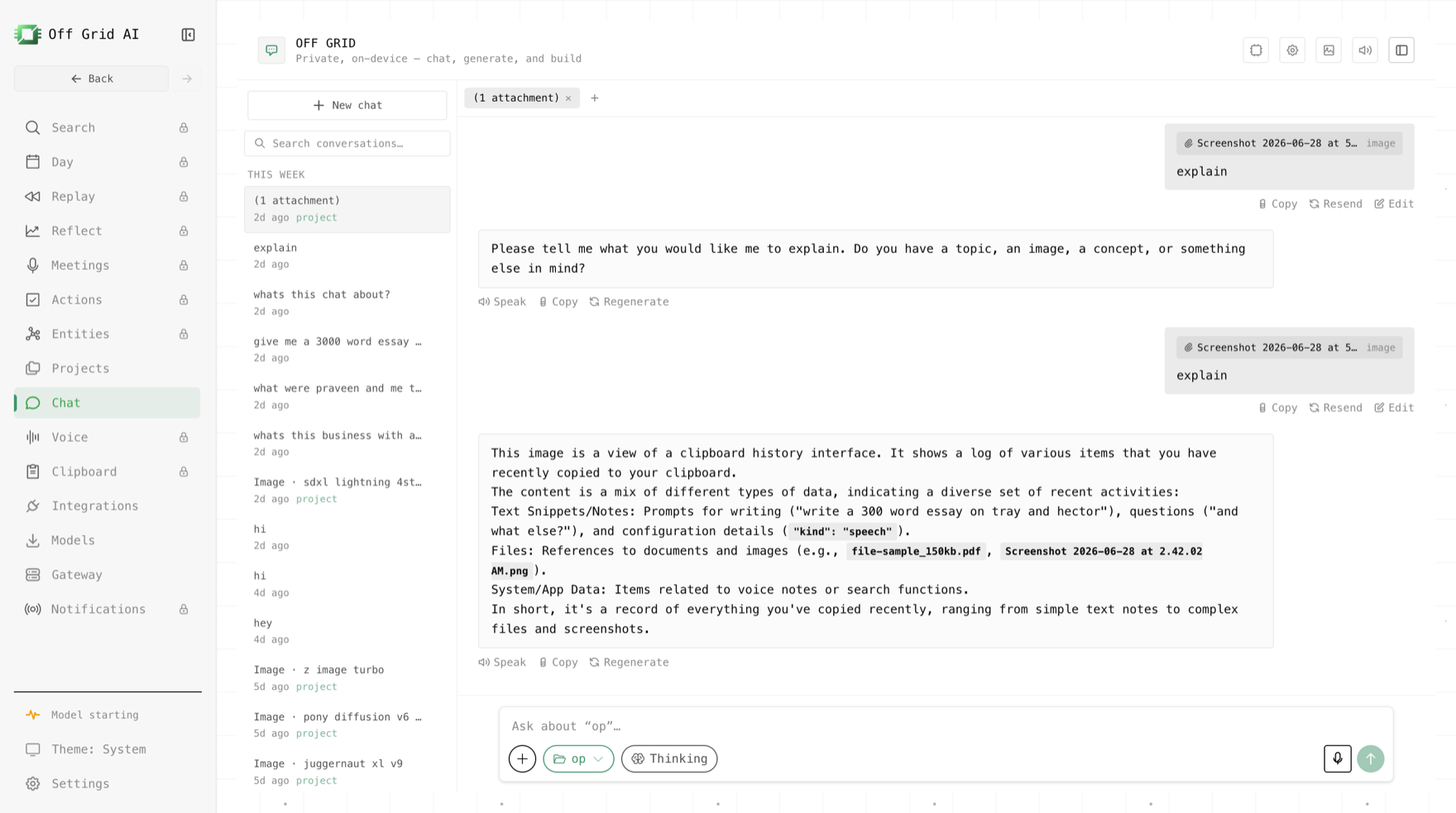
OGAD’s Projects and document chat are core features. Download the app and a suitable local text model, and complete local search setup before you disconnect. A readable file and a selected local model are more useful here than a large collection of unreviewed material.
Set up a project for the workshop
- Select a downloaded model in Models > Text.
- Open Projects > New project, enter a name such as “Onboarding workshop report,” and press Enter.
- In Knowledge & settings > Knowledge base, use Add files to import the source pack.
- Wait for the files to be indexed and leave the relevant retrieval switches enabled.
- If Include captured memory is available, turn it off for this source-only task and save.
- Open Chats > New chat from that project.
The Projects interface supports project instructions and file selection. Keep this workshop’s working conversations in its own project to reduce unrelated context.
Extract the evidence before writing the report
Ask for a structured first pass:
Review these workshop notes. Separate explicit decisions, proposals, disagreements, facts stated by participants, and unanswered questions. Name the source file for each item. Do not treat a suggestion as an agreement. Mark unclear ownership and missing dates rather than filling them in.
Read the output against the notes. If the transcript says “we could try this next month,” do not accept a row that says “launch next month.” Correct the wording before you ask for a report.
A useful working table looks like this:
| Item | Status | Evidence to retain |
|---|---|---|
| Test a shorter onboarding form | Agreed experiment | Exact decision note |
| Remove the verification step | Proposal | Who raised it and what remains unresolved |
| Review abandonment data | Follow-up | Named owner, if explicitly assigned |
| Publish the final process | Not yet decided | Approval dependency |
These are fictional examples. Use the same separation for your actual workshop rather than copying the sample conclusions.
Draft around decisions and unresolved work
Once you have checked the table, ask:
Draft a report for the client sponsor using only the reviewed notes below. Use sections for purpose, main findings, agreed decisions, open questions, and next steps. Keep proposals separate from approvals. Do not add a deadline, owner, or claim that is not in the notes. Keep the report under 700 words.
Paste the checked table or notes with the request. This reduces the chance that a broad retrieval question brings back an incomplete mixture of material.
For the onboarding workshop, the report can explain the problem, the agreed test, and the decision still needed about verification. It does not need to reproduce every idea that appeared on a sticky note.
Preserve disagreements that affect the next step
A report can be readable without pretending that everyone agreed. Ask for neutral wording where two participants gave different accounts:
State the two positions and what evidence or decision would resolve the difference. Do not choose a winner unless the notes record an explicit decision.
For example, the sales team may describe the form as a barrier, while operations says some fields prevent fulfilment errors. The useful output is the question to test, not an invented consensus.
Keep sensitive attribution proportionate to the report’s purpose. An internal version may need named owners; a wider summary may need only roles. Check the audience before sharing either version.
Check the report in three passes
First check facts: dates, figures, product names, and statements attributed to participants. Then check decision status: approved, proposed, rejected, or unresolved. Finally check next steps: each owner and deadline must come from the source or be clearly marked as a proposal for approval.
If the report cites a file and text part, open that material. A reference helps you locate evidence; it does not guarantee the model’s interpretation.
For a long workshop, review each agenda section separately. Project search retrieves selected passages, so a single question can miss the final decision at the end of a transcript. Keep a manual agenda checklist and combine the checked section notes afterward.
Keep a usable record of the result
Copy the approved report into your usual document tool. Record the workshop date, report version, and who reviewed it. Keep a short appendix linking conclusions to source filenames if the report may be questioned later.
The model has prepared text, not issued approvals or updated a project management system. Use your normal process to confirm assignments and circulate the report.
Try OGAD with one workshop’s notes. Start by separating decisions from suggestions. That small step gives the final report a stronger basis than asking for a polished summary immediately.