
You have a work email in another language and need to understand what the sender wants. OGAD (Off Grid AI Desktop) can help explain a saved copy using a local text model on your computer. After setup, the language task can run without internet. Receiving a new email or downloading an attachment still needs whatever connection your email service requires.
| Download OGAD | Desktop releases |
What would you like to do with Off Grid AI?
Want help with this workflow, or a feature you would like us to add? Email support@offgridmobileai.co with your devices and the task you want to improve.
Save the material before going offline
Make sure the email and any relevant attachment are available on your computer. A message preview or a cloud attachment placeholder may not contain the full material.
Copy the relevant text into a local note. Include the subject and the part of the conversation needed to understand the request, but remove unrelated signatures and private details. Keep the original wording beside your working copy.
Suppose a supplier writes in Spanish about a revised delivery date. You need to know whether the date is confirmed, proposed, or conditional on your reply. A fluent English summary that loses that distinction could cause a mistake.
Start with the question you need answered, such as “What decision is the sender asking me to make?”
Choose a model that can handle the language
Install OGAD and download a local text model suitable for your computer and the source language. Language quality varies by model and language pair. A model that handles English well may not handle your supplier’s language or technical terms equally well.
Under Models > Text, select the downloaded local model. Try a short, non-sensitive sample whose meaning you can check before relying on it for work. Complete setup while connected, then repeat a small test after disconnecting.
This is a text task. You do not need a speech model, voice mode, or a meeting recorder. Core chat is enough for a short pasted email. The desktop releases provide the app; model choice determines the language capability you are testing.
Ask for the meaning before a polished translation
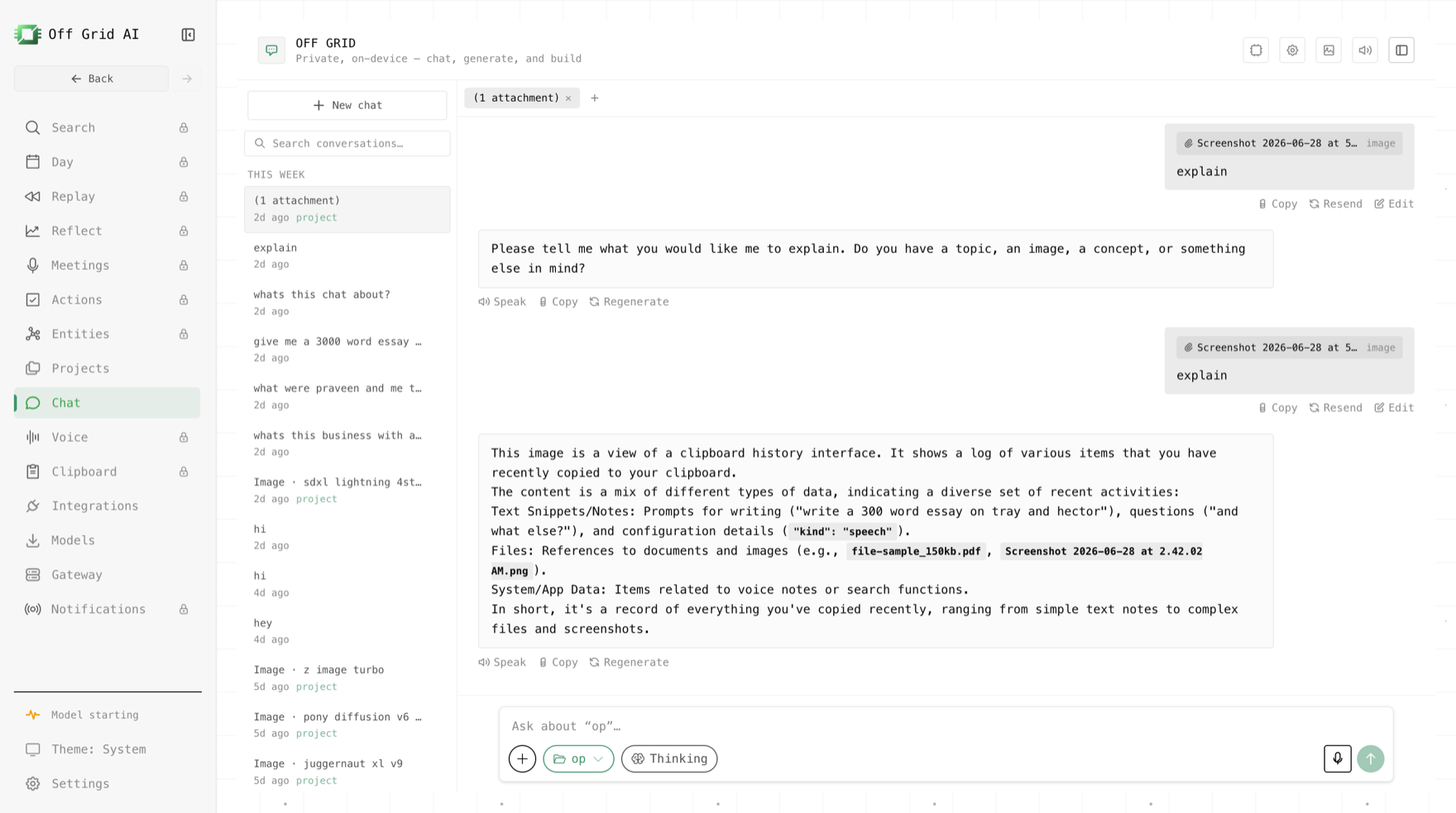
Paste the saved email into a fresh chat and give a narrow instruction:
Explain this email in English. Identify the main request, any proposed or confirmed date, what I am expected to do, and any condition attached to the request. Preserve names, product codes, amounts, and dates exactly. Quote the source phrase for any important uncertainty. Do not draft a reply yet.
Compare the answer with the original. If the model says delivery is confirmed, ask which exact phrase establishes confirmation. Words that express possibility, politeness, or a condition deserve special attention.
Treat the answer as a reading aid. If the decision is important and the wording remains unclear, ask the sender or a fluent reviewer rather than choosing the most convenient interpretation.
Keep the action separate from the background
A work email often mixes context, a request, and a courtesy phrase. Ask for a simple table:
| Item | What you need to establish |
|---|---|
| Main request | What response or action is expected? |
| Date | Is it a deadline, proposal, or confirmed event? |
| Dependency | What must happen first? |
| Amount or quantity | What exactly is stated? |
| Unclear phrase | What requires confirmation? |
For the supplier example, the action might be to confirm whether a proposed delivery window works. That is different from placing a new order or accepting changed terms.
Do not let a summary turn background information into an instruction. A mention of an earlier problem may explain the request without asking you to take a new action.
Ask for a close translation when details matter
After the first explanation, request a sentence-by-sentence version:
Translate the relevant paragraphs into English. Keep each source sentence next to its translation. Preserve uncertainty, conditions, and negative statements. If a phrase has more than one plausible meaning, show the alternatives and explain what context would resolve them.
This side-by-side format makes it easier to inspect the parts that affect your decision. It also lets a colleague review one phrase without reading a long AI conversation.
For long email threads, process the current message first and add earlier messages only where needed. Label who wrote each message and its date. Otherwise, the model may confuse an earlier request with the latest instruction.
Check the details that can change an action
Names, codes, dates, and numbers should get a separate pass. Check them directly against the source:
- Did the translation keep the same product or project code?
- Is the day and month order ambiguous?
- Is a number a quantity, a price, or a reference number?
- Did “not before” become “before”?
- Did a proposed date become a definite commitment?
Ask the model to list these items, but do not rely on that list alone. Use the original message as the final reference.
If a date such as 04/05 could be read in two ways, ask the sender to state the month in words. The model cannot know an unstated convention with certainty.
Draft a clarification rather than guessing
Once you know what remains unclear, ask for a short message:
Draft a polite clarification in the source language asking whether the stated delivery date is proposed or confirmed. Do not accept any change. Show an English version underneath so I can review the intended meaning.
Review both versions. If you cannot judge the source-language wording, use a fluent reviewer for a consequential message. A second model response is not independent proof of correctness.
Copy the approved text into your normal email tool when you are ready to send it. This workflow does not automatically read your inbox or send a reply.
What if the model struggles?
Shorten the input to the relevant paragraph, supply a small glossary of technical terms, and ask about one phrase at a time. If the model repeatedly changes names or ignores conditions, stop using that output for the decision and try a more suitable model or human help.
Keep remote models and online tools out of the chat if you need local processing. Internet-free reading also depends on having the complete email and required model files already stored locally.
Download OGAD and try one saved email. Start by identifying the request and the condition attached to it. That gives you a practical answer you can check before you act.